

Oftentimes scientists, from physicists to biologists, get so engulfed in their work that they eventually forget about the beauty which compelled them to study it in the first place. Constant exposure to numbers, equations, and regimented thinking has the potential to wear down their ability to think outside the box, and be childishly curious about the unknown.
Poets and artists use their passions to escape the regimented reality that can often be seen in the scientific fields. They relish in the opportunity to think boundlessly, viewing metaphysics as a more worthy pursuit than actual physics.
However, science at its purest form is also an art. An art of using what we understand in the natural world to look for new knowledge, even if that sometimes means starting from a new canvas entirely.
By combining science and more traditional arts, both fields are respectively enhanced. Artists can use science to gain a deeper understanding of the wonder of the natural world, so that they are able to create even more wonderful metaphysical worlds. Scientists who are also artists are able to better appreciate the beauty of their work, and come to new conclusions with logic not previously used.
We were inspired to explore what link there may be between writing a creative poem about a piece of art and the simultaneous process of scientific creativity during this exercise.

For the image below, different lineages of Bacillus subtilis bacteria were randomly applied on a Petri dish and allowed to grow. As the bacteria spread, cells from each lineage organized themselves into distinct communities as shown by the colors in the image. The confocal micrograph image was part of a project where scientists aimed to design artificial intelligence circuits in bacterial colonies and plant circuits.
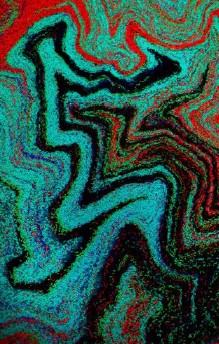
Of endless interplay.
Nelson Martín Manstein
The vibrant, swirling patterns of the image point to a deeper scientific truth: bacterial colonies and biofilms are not chaotic; rather, they’re highly organized, self-assembled systems exhibiting a unique behavior. Just like abstract waves, biofilms grow in complex, often fractal-like structures, all being a consequence of how bacteria communicate and interact. The convergence and ‘dance of complementary colors is particularly interesting. This image is shaped by chemistry, cell communication, and cooperation. The swirling forms almost resemble oscillating chemical reactions and nutrient flow inside the microscopic world of the biofilm.

Caravaggio’s The Seven Acts of Mercy masterfully depicts the interplay of light and shadow, revealing the depths of our humanity and highlighting acts of compassion. The dramatic chiaroscuro technique follows the movement of light through darkness and reminds us of principles of physics such as the reflection of light. This effect symbolizes spiritual illumination and philosophical insight, much as when humanity came out of the ‘darkness’ of the Middle Ages and entered the Renaissance and Enlightenment periods. The light also symbolizes the journey from birth to death—seeing ‘the light’ as we enter and leave life. These insights inspired ekphrastic poetry as a means to explore light as both a physical phenomenon and a metaphor for revelation, faith, and the cyclical nature of our existence.
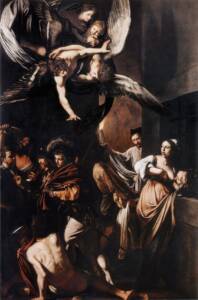
The Seven Acts of Mercy by Caravaggio (1571-1610)
LIGHT
From a droplet
I saw the Universe
Of color twinkles
Pleased to observe.
Elusive traveler,
Your absence soothes,
Often despairs.
Equally charged,
Photons, emotions.
You carry life,
Carry our souls.
Lead to discover,
From the abyss
Within our souls,
Into our minds,
Into the core
Of man and Universe,
Ever so bound.
Gate to my travels,
Cyclical partner,
A lapsed goodbye
Takes you away,
Until I thee
See once again.